This week started out with a bang. We did my favorite Old Testament FT. It is the Shfeylah (or shphelah) trip. Shphelah means “to be low, or lowland”. It denotes the low lying hills that slope down to the coastal plain, and are an important fertile and strategic part of Israel. Going West to East, the Kingdom of Judah had 3 different types of terrain. The first is the coastal plains, then you get the low hills, then the high hills in which Jerusalem and Bethlehem reside. The word shfeylah is not in the KJV, though it is used 20 times in the Hebrew text. It is sometimes translated as “vale”, or “valley” or “plain” or “low plain” or “low country”.
The most recognizable way for you to know it is “shphehlah” is when it has the combination of hills, valley and plains. Then you know it is high hills, low hills (shphehlah) and coastal plains.
Because the Philistines held much of the coastal plain, and because so many invaders (such as Egypt, Assyria, Babylon) traveled along the coast and tried to enter Judah from there, the five valleys that go through the Shphelah became important strategic centers. Thus they fortified a major city in each valley to protect that entrance (and probably to levy taxes/tariffs as well). It is worth learning the name of each valley and its attendant city: Ayalon Valley, Gezer guards it; Sorek Valley, Beth Shemesh guards it; Elah Valley, Azekah guards it; Guvrin Valley, Mareshah guards it, it’s the way to Hebron; Lachish Valley, Lachish guards it.
We first go to Tel Gath, which we can do because Jeff Chadwick excavates there. He takes us through it, showing us the Canaanite level, the Philistine level, the part where Goliath would have lived, and the Israelite part. It is a great site, I love it. N. 31* 42.117, E. 034* 50.845.
 Chadwick teaching the students about his excavations
 Me watching Chadwick teach (which means I don't have to teach for a moment, kinda nice)
After that, we went to Guvrin. Guvrin was the town that rose up when Mareshah died out, was important until Bar Kokhba revolt of ca 130 AD. When they figured out they could mix the limestone into plaster, and eventually figured out firing it made very good plaster, mining for limestone in this area became a big thing. This was used for cisterns and walls. They would punch through the hard black top, a hard limestone called Na’ari. When they got to the soft limestone they would mine it in ever widening circles, (about 30 cm deep, you can point out the lines inside). Since each lower row was larger, this made a bell shape. Hence these are called the bell caves. All the caves we go to are Byzantine (inside we find crosses) but some nearby are from Iron Age II. We sang songs inside and enjoyed the incredible acoustics. Then we did some battle yells.
 Students singing in the Bell Caves
Our whole family was with us on this field trip, and as usual, they had a great time in this cave. Little Jacob recognized where it was as we got off the bus, and he was so much fun to watch as he ran around jumping, sliding, yelling, and having a great time.
 Playing in the Bell caves
After this we went up to the entrance of Tel Mareshah. It was an important site. Joshuah conquered it. Solomon built it up, but it was made a greater fortification by his son, Rheboam. Asa, king of Judah fought a battle there that he won with the help of the Lord. Here we go to a Columbarium, which is a dove-cote. This is important because they used doves for food, for fertilizer, but also for sacrifices. Joseph and Mary offered two doves when they brought baby Jesus to the temple. Those doves probably came from a place like this.
 Sabrina inside the dove cote
 BJ and Jacob in the dove cotes
We also went to an ancient olive press. There we spoke of how olive oil was made and how this symbolism teaches us about the all important atoning sacrifice of our Lord and Savior Jesus Christ at Gethsemene (Greek version of the Aramaic word for Oil Press).
From there we made a quick stop at the Sidonian Tombs. After Babylonian destruction of the temple, this area was taken over by Edomites (called Idumeans by the Romans). One tradition holds that Herod was from Maris (Mareshah). These Idumeans largely adopted Hellenistic culture (and later Roman). While some Jews and Egytpians lived here, the largest groups were Idumeans who were joined by Sidonians and Greeks. These tombs are Hellenistic, and as a result have very Greek style decorations.
 Greek decorations in the Sidonian tomb of Mareshah
 Greek tomb decoration. This is a three headed dog, either Cerebos or fluffy. You don't see a three headed dog every day, even if you are in the business.
 Jacov inside the Sidonian tomb
The kids (and students) love running around in these things and hiding, etc. Jacob recognized the place in the parking lot (he has an amazing spatial memory). He went right to his favorite tomb for hiding, and ran around and around in it. What fun!
After this we went to Lachish, my favorite tel. (954 ft. elevation, N 31* 33.942, E. 034* 50.916) It is huge. It was the most important city outside of Jerusalem, and was larger than Jerusalem at the time of the Assyrian siege, or at least just before it. It is a huge place. It has a Canaanite palace and temple which Joshua would have conquered after defeating their army in the Aijalon Valley. It was a fortress for a long time, made especially large by Rehoboam, Solomon’s son. But the big stories there are the Assyrian and Babylonian destructions. Lachish is the last city to fall before each of those armies went to Jerusalem. The Assyrians built a huge siege ramp, still visible today, because that was the only way to get in. The Israelites built a counter siege ramp, tearing down houses and roads to build it up to support the wall against the pressure being put on it by the Assyrians. They Assyrians were known for their horrible treatment of conquered enemies. They ruled by fear, trying to make people afraid to rebel because of the terrible things that would happen to them. They cut hands and feet off of conquered enemies, raped and plundered, flayed and impaled them. Surely those inside Lachish looked out of their walls and saw their friends from Azekah, the city that fell right before theirs, being tortured and impaled in the valley around Lachish.
 Tel Lachish
As we go through the large gate that Rehoboam built I have the students turn and look at the lintel and try to picture their ancestors desperately holding a door closed, pressing it against that stone as the Assyrians tried to break through. (we also talk about the Lachish letters, and read the one that may be talking about Jeremiah). Then we go up on top of the countersiege ramp and wall and look down, trying to picture the Assyrian army. We then switch gears to talk about Babylon, who did the same thing in the same place. I point out where Azekah is (it was too hazy to see today). Then we read the Lachish letter that talks about how they could no longer see the signal fires of Lachish. I try to have them picture what it would be like to see those fires go out, to know that Azekah had fallen, and that you are next. You are all that stands between the Babylonians and Jerusalem. No one will come to your aid. You are all that is left, and the army is coming your way. This is dramatic stuff. I then ask my students to think about how in our life we sometimes see the watch fires go out, comparing it to when we feel the spirit leave. When that happens, we know we are in as dangerous circumstances as the Lachish residents were when those watch fires went out. We better pay attention to things when we sense that spirit leaving and do something about it or we will fall too.
It apparently has some effect on my students. This is what one of my students wrote on her blog:
The most meaningful part of Lacish to me was what Brother Muhlestein talked about at the entrance to the city (see picture below). He had us imagine being an Israelite inside the city with the formidible Assyrian army attacking the door with a battering ram. We imagined our Israelite ancestors holding that door shut with all their might, knowing what would happen to their wives, daughters and families if they got in. I cannot fathom the despair and heartache they must have felt when the city fell. We also talked about the Lacish Letter #4 that was found. A near-by town called Azekah (in the time of the Babylonians) had their signal fires lit, but when the Babylonians destroyed their city, their signal fires went out and the Israelites in Lacish knew that the Babylons were victorious and that Lacish was next to be destroyed. Again, I can't fully comprehend the dread that must have filled their souls when the lights at Azekah went out. Brother Muhlestein applied this to our spiritual life and I will never forget the words he said there to us.
 Pointing out the threshold to students
 Students watching Jeff Chadwick point out features of the Canaanite temple at Lachish
We also toured the palace, and an old temple. I gave them time to write in their journals, and then off we went. During this stuff we tried to have some fun too. As we were looking at the siege ramp, pointing out where the big stone and brick wall was, where they found in one 5mx5m square over 100 arrowheads lodged in the brick, suddenly Julianne, Tashara and Sabrina appeared on the top of the wall and threw rocks at us, trying to protect the city. We were far ahead of the Judd class by then (that never happens), so when they showed up below we were already on top of the wall, so we threw stuff at them. They didn’t like being identified as the Assyrians, but what could we do, they looked like Assyrians to us?
From there we went to the Valley of Elah. We talked about how the whole thing happened, pointing out the geographic features of the area that bring the story to life. As great a story as it has always been, there in that valley it seems so real that it becomes all the more powerful. It is a great place to teach about the faith and perspective of David. You can see where Saul’s camp would have been, up towards Sha’araim. They camped there because the Philistines had been coming up from the West and had gone around Azekah (not a huge fortress at that time) and were coming up towards Bethlehem and Jerusalem, which are almost straight east from there. The Philistines were the south hill, so the Israelites made a camp on the north hill (north of the valley and brook of Elah, pronounced ey-lah) just east of them to stop their advance. Then David comes and demonstrates such incredible perspective and faith. It is a great story.
 Students looking for stones to sling
 Sabrina about to kill Goliath
 Sabrina cutting Goliath's head off
To illustrate the story we had Sabrina do her third and final David impression. Little Sabrina, not quite 3 feet tall, got out her sling and came against 6’4” (skinny, but tall) Morgan. She totally took him down, and stood on him and cut his head off. It was a fine moment, I was very proud.
When David slew Goliath, the Israelites chased after the Philistines, who left so quickly they left their tents and everything behind. Just west of the battle site the valley turns north, then curves to the west again, making an “S” curve, as I spoke about last week. The Israelites caught up to the Philistines just on the other side of the curve, just before they were about to head west again. I think this was because you go slower as you turn, and because the Israelites could come down off their camp going two directions, thus chasing them from behind the curve, but meeting them on the other side of it as well. Then they slew them all the way to Gath.
In order to more fully get this, we went up onto the top of Azekah. (1033 ft. elevation, N. 31* 33.947, E. 034* 50.965) There we talked about the short history of the site. It became the great guardian city of that valley. Also, from there, you can see the valley very well, and we got a great vantage point to further understand the story. And we sang the classic Chadwick song “Goliath’s back, and you’re gonna be in trouble.”
 View from Azekah of the valley where the battle took place (furthest to the right and up in this picture), and the first part of the S curve that goes around Azekah
Then we went to Bet Shemesh. (863 ft. N. 31* 45.027, E. 034* 58.536) This was the guardian cit for the Sorek Valley. There we read about Amaziah losing a battle to Jehoash, a battle which he had sought for and which led to the pillaging of Jerusalem by the Northern Kingdom. We also looked around at where Samson was from, where he killed a lion, set fire to fields, etc. Heady stuff. Then we talked about the story of the ark of the covenant being lost, how it afflicted the Philistines, and how it was returned to Israel in the valley we were looking at, and was brought to Bet Shemesh, where we were standing. We spoke of how we all need our own Bet Shemesh, a place where, when we have lost our covenant because of our wickedness, we can let the Lord bring it back to us. Break the covenant we surely will. When we do, lets run to Bet Shemesh, or in other words, lets repent and let the Lord restore us in his way and time.
 Jacob and Sabrina at Beth Shemesh
 Tashara near the walls of Bet Shemes
It was a great field trip, we loved it.
The next morning we did another great field trip. We went to the City of David. We looked at the geography of the whole place. We talked about why it was built where it was, how its topography and political geography made it a great capital. We read Psalms and prophecies about Jerusalem. Then we moved below and saw the building that I think has to be David’s palace, which later became an administrative building after Solomon built his palace. Think of the things that happened there. David lived and loved there. He saw Bathsheba from there, and you know how that story ends, there in that palace. Solomon lived there. Probably Isaiah worked there, even prophesied there. Jeremiah probably prophesied there and was probably imprisoned there. There is a decent chance that Lehi was there. The excavators found there seals bearing the names of people that we know persecuted Jeremiah, and maybe even Lehi. What a place.
 The corner of David's Palace
Then we went just below there. We look at the remains of houses that were there in Jeremiah, Lehi, and Zedekiah’s day. There is evidence of burning in those houses, and arrowheads. These are houses that were destroyed by the Babylonians. One of the houses had a seal from someone that we know helped Jeremiah. Then we looked over the valley and again tried to picture what it looked like to have it filled with either the Assyrian or Babylonian army. Judah was delivered once, under a righteous king who listened to the prophet, but later they didn’t, when they chose not to listen to the prophet.
 The room on the right was burned and had arrows in it
 Many in my class looking down at the houses that were burned by the Babylonians
We went down to touch the early walls, the walls that David had to deal with when he took the city, and then that he used. These walls very well may have been built by Melchizedek, so we talked about him. We were roughly in the place where Isaiah met Ahaz and delivered a prophecy about a virgin conceiving, so we talked about that. What a historic place.
 Students touching what very wall may be "Melchizedek's stones"
From there we went through Hezekiah’s tunnel. It is a tunnel he built to take the water from the Gihon spring to the Pool of Siloam. It took the water under the city, and thus kept it inside the first wall, rather than having it outside that wall so that if the lower wall fell the water was vulnerable to the Assyrians. This is a very long, very cool tunnel, going right under the city. You enter at the Gihon spring, and walk through water, sometimes bending over quite a bit, sometimes squeezing through. It is a great experience. We always turn out our lights part way through and go a ways without lights. We also sing in there. Good stuff. Just as you enter the spring you are on the ancient gate towers of the city. It was there that Solomon was anointed king after riding on David’s ass. My guess would be that this made it the traditional site of coronation. For good measure we re-enacted it by anointing Kaleb king. He seemed to be okay with this.
 The Gihon Spring
 Part of the tower at the Gihon Spring
 Anointing Kaleb King
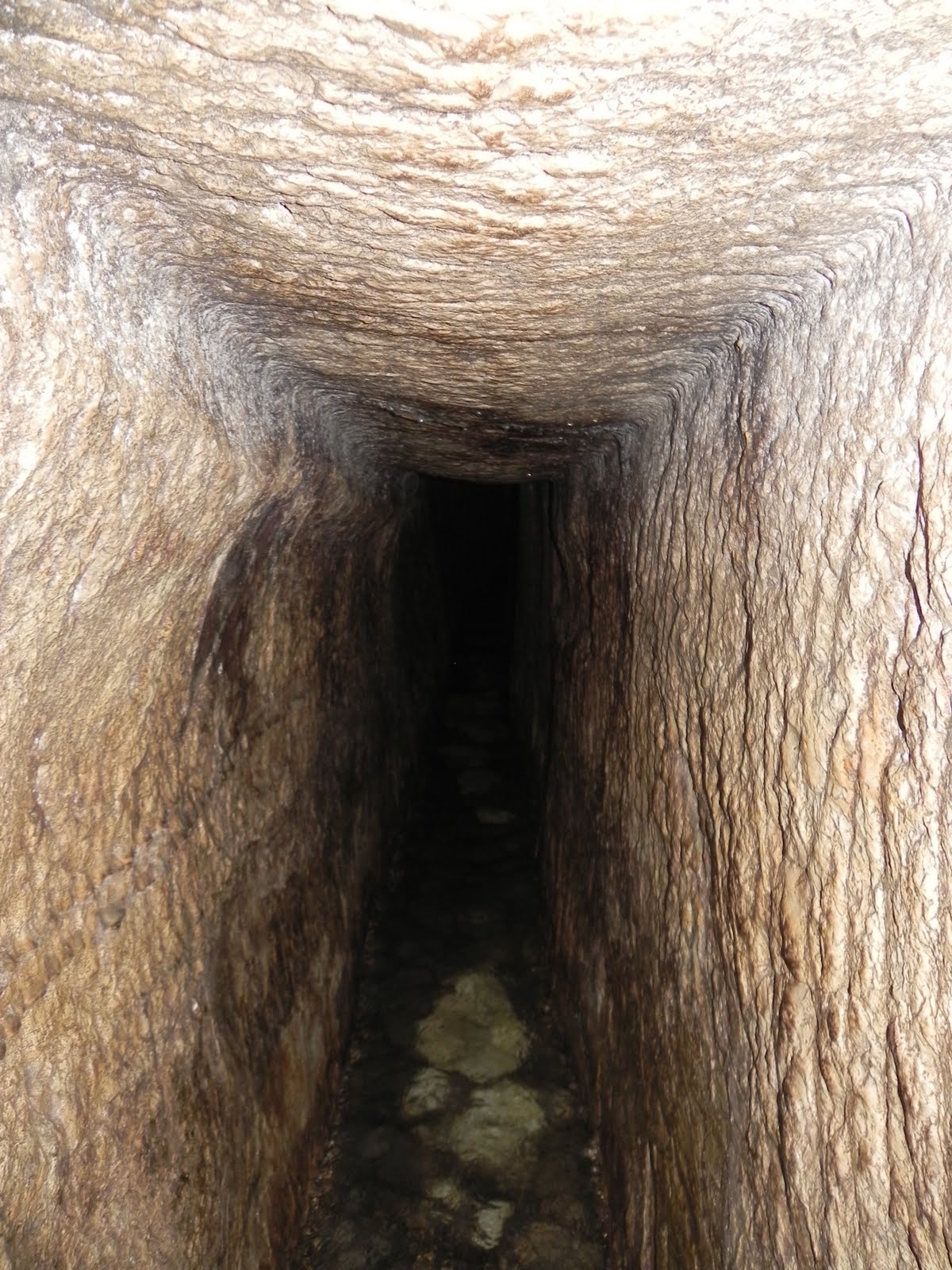 Inside Hezekiah's Tunnel
 Kaleb and BJ and Josiah inside the tunnel. Kaleb and BJ were the only family members to come on this field trip with me.
When we get out we go to the Pool of Siloam and talk about the miracle of the man who was born blind and was healed when Jesus sent him to wash at the Pool of Siloam. After we go through the story and the great line “whereas I was blind, now I see,” then we talk about how Jesus Christ does that for all of us, and hopefully many times. It is a wonderful moment.
 The Pool of Siloam

My class at the Pool of Siloam
After that we went through the quarry, and then talked about Solomon’s temple, and then we were done. I hung out in the city for a while with BJ and some of the students. We went to St. Peter of Galicantu church. I love that church. Finally I got home and we worked on various things, including having a wonderful family home evening.
 Candles at St. Peter of Galilcantu
 The stairs at St. Peter Galicantu on which the Savior probably walked as he was led to trial
We were back to great classes after that, and a whole bunch of Jordan Orientation things. It is weird to think this will be our last time going to Jordan. Its going to be hot, but I’m sure it will be good. We also had a court of honor, where BJ received his Star award, and Kaleb got his wolf and bear. We had a field trip to the Separation Wall that was almost worthwhile. And Kaleb, Tashara and Alexia had a recital for their guitar class. They each played a few songs. They were great. I think we are in for some good guitar playin’ in our family. We had a great forum speaker from the American Embassy. We had our Seder dinner, which went very, very well, probably the best yet. Julianne works so hard to get those things ready. She really does a fantastic job. She is so good at this kind of thing. We also had lunch this week with a new faculty member we just hired in Provo, named Matt Grey. He is here doing an excavation, and came to be with us for a few days. It was good to get to know him better. We also had him and the Judds over for dinner and got to know him better. He has some great ideas and I think we will end up doing some cool things together in the future.
 Alexia playing guitar
 Kaleb playing guitar

Tashara playing -- you guessed, the guitar
 The whole guitar class
 BJ getting his Star
 Kaleb getting his Wolf
Getting Ready For Seder Meal!!!
lur="try {parent.deselectBloggerImageGracefully();} catch(e) {}" href="https://blogger.googleusercontent.com/img/b/R29vZ2xl/AVvXsEjx3OeclSWRtXG1Bw03NVhNrR_j7WyYb8PBcxFgKGcwrrmUA7xGtr8oyriRc6AZ9kqbkAA3z427MVf4WTOiwWlDNGmVQaMajwL90Ln4oq6aj-G62Lwiu5GKWjqWi7Q2SRaK18bpHsOVN-Ke/s1600/DSCN9178.JPG">


This week we also had a bunch of students get sick. We ended up with over 30 of them very sick (that is over 37%). Some of them were violently sick. I spent a lot of time going from room to room, giving blessings, making sure they were okay, cleaning up messes, and just trying to help these poor students feel like they are not alone as they suffer through this stuff. Moreover, it is the time of the semester where there are so many things due, and people are so worn out, that a lot of people feel frustrated with whether or not they are progressing the way they would like. I spent a lot of time talking with one wonderful student or another about these things. They are so wonderful and have such a great future ahead of them, I love helping them see their potential. I also worked a lot on my book about God’s Love in the Old Testament. It is almost done.
So, we wrapped up a typical week at the JC. BJ got his cast off. We had something every night of the week, a ton of extra things during the day. Our family did a lot together, a lot with other people, we got behind on some things, caught up on other things, anointed one son king of Israel, and in general wore ourselves out. The good news is that I understand everything we do better because, like David, sometimes I see that we are in the army of the living God, and because through the power of Jesus Christ, whereas I was spiritually blind, now I sometimes see.


 Justin pulling Kaleb on the threshing sledge